
Linen Upholstery and Shrinkage Risk
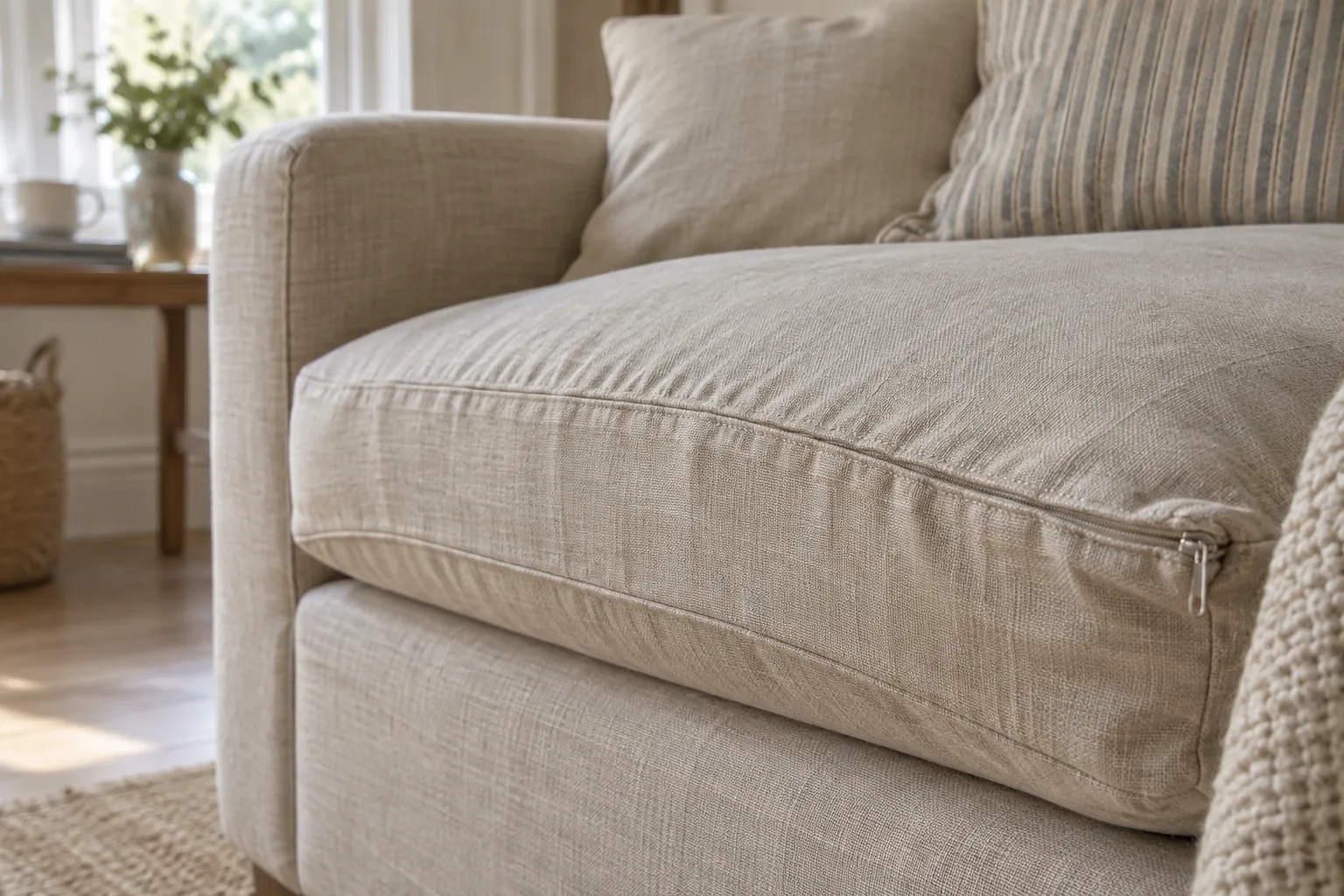
Direct answer: A linen or linen-blend sofa cover can change size or drape after unsuitable cleaning. Check the exact fabric and cover label, including drying directions, before washing. A zip does not itself confirm that laundering is safe.
A loose-looking linen sofa cover can seem easy to remove and wash. Yet a small change in its dimensions may make it difficult to put back over a foam cushion or around a frame. “Linen look” is also a description of appearance, not proof that the fabric is pure linen. Many upholstery textiles blend linen with cotton, polyester or viscose and use a backing that behaves differently from the face yarn. Before washing or wet cleaning, identify the exact cover and its care instructions.
Shrinkage is only one possible change. Seams can pucker, a cover can lose its relaxed drape, dyes can move and a washed panel can become visibly different from the fixed parts of the sofa. That does not mean every linen cover is unwashable. Some makers explicitly allow machine washing for a particular product. The safe decision depends on that product, its construction and its current condition.
Read the whole label, not only the fibre name
Look beneath the sofa, inside a removable cover and in the original furniture paperwork. A label may specify a washing temperature, separate washing, drying restrictions or professional cleaning. If only a generic care code is present, contact the maker with the model and fabric name. Retailers often sell multiple covers for the same frame, each with different instructions. A neighbour’s similar-looking sofa may not be a useful comparison.
Pay attention to whether the cover is fixed or removable, and which parts come off. A zipped cushion cover may still have a different backing fabric sewn to its edge. A fitted frame cover can be harder to reinstall than a small scatter cushion. If the maker says to wash all matching covers together, cleaning only one stained seat might create a colour or texture mismatch. If they say not to tumble dry, a short warm cycle in a dryer is still a departure from the instructions.
The size of the cover matters. A slight dimensional change in a loose throw may be tolerable, while the same change in a fitted seat cover can place strain on the zip and seams. Some manufacturers allow for a specified amount of shrinkage after first cleaning. That is a property of their product, not a safe percentage to assume for every linen sofa.
Before you clean linen upholstery
- Find the model name and instructions for each removable and fixed part.
- Photograph seam alignment and fit before removing a cover.
- Treat a fresh spill only by the method the maker permits.
- Ask a cleaner how the proposed process will protect fit, dyes and backing.
Where shrinkage risk comes from
Natural fibres can respond to moisture, agitation and heat. The upholstery fabric may have been pre-washed or stabilised, but you cannot infer that from its appearance. The weave, lining, stitching and finish can all change how a cover behaves. A blend with a small linen content may still have a care label that permits washing; a different blend may require a more cautious process because another component is sensitive.
Fit also depends on what happens after washing. A cover may look roughly the right size while flat, then prove tight around a shaped foam insert. Pulling hard on a damp or shrunken cover can stress the zip, distort a seam or compress the cushion unevenly. The mattress or sofa cushion filling itself should not be put into a washer merely because the cover unzips. Check whether the maker says to refit the cover while slightly damp or only after complete drying; different products give different instructions.
Some apparent “shrinkage” is actually a change in drape. A relaxed linen cover may crease and settle differently after cleaning. Compare measurements and seam alignment rather than deciding solely from a photograph. If it no longer reaches the intended fastening point without force, stop and ask the supplier. Do not stretch a delicate seam until it tears.
What to do with a spill on a linen sofa
For fresh liquid, blot gently with a clean white absorbent cloth. Avoid rubbing the open weave. Check the label before adding water or product. A spot treatment may leave a ring on a wider panel if soil moves to the wet boundary, so more wetting is not automatically a solution. Record what was spilled and any product already applied. If the sofa is valuable or the fabric is unknown, early assessment is more useful than repeated experiments.
If a line appears after a wet patch dries, the guide to water rings on fabric sofas explains why more water may move the edge. Send the cover label and a dry photograph through the contact page before deciding on further treatment.
Vacuum routine loose dust with a suitable upholstery tool if the manufacturer permits it. Work gently along seams and piping. A rough brush can raise fibres and change the fabric’s appearance even when no shrinkage occurs. Do not use bleach or a hot iron on a fixed cover without explicit manufacturer guidance. A removable cover that can be ironed still has to be treated according to its own label.
If the sofa has suffered a large spill that reached the filling, washing the outer cover alone will not address the inner moisture. Check the cushion and frame for dampness and discuss the extent with a professional. A fresh-looking cover should not hide a wet insert that needs a separate drying plan.
How a professional should plan treatment
Show the cleaner the care label, purchase details and affected parts. They should examine the face fabric, backing, seams, trims, filling and any existing distortion. A limited test can help identify colour movement, water marking and changes in texture, though it cannot guarantee how an entire cover will fit after a wash. Ask whether the proposed work treats the cover on the sofa or separately, and why that method fits this construction.
For a removable washable cover, the maker’s instructions remain the starting point. A cleaner may recommend treating all matching covers together to avoid an uneven appearance, but the decision depends on their condition and labels. For fixed or uncertain upholstery, a controlled method with limited moisture may be considered. “Low moisture” is not a magic guarantee against shrinkage; it simply describes one part of a broader risk assessment.
Our sofa cleaning service can inspect the upholstery and discuss whether a proposed treatment is appropriate. If a cover has already shrunk, cleaning it again is not a reliable way to restore the original dimensions. The maker or an upholsterer may be better placed to advise on a replacement cover or repair.
Decide on the whole sofa, not one panel
Before treatment, photograph seams and cushion fit on each side of the sofa. Check whether one cover has faded in sunlight or worn differently from the others. Even if all panels can be washed to the same specification, older fabric may react less evenly than a new cover. Ask what differences would be considered normal wear and what would indicate a treatment problem.
After any permitted cleaning, allow covers and inserts to dry as directed before judging the fit. Refitting a damp cover without instructions may trap moisture; waiting too long on a product designed for damp refitting may make the job harder. Follow the exact maker guidance. A cover that looks crisper or more wrinkled than before is not necessarily damaged, but a strained seam or misaligned zip warrants attention.
The sensible objective is to remove appropriate soil while preserving the sofa’s fit and construction. Sometimes that means a washable cover can be cleaned confidently. Sometimes it means a stain is better left partly visible than exposing the whole piece to an unapproved process. Knowing the product’s instructions turns that into an informed choice.
Frequently asked questions
Does every linen sofa shrink?
No. Construction and preparation vary, and some labelled covers can be washed. The product instructions are more useful than the fibre name alone.
Can a cover that became tight be stretched back easily?
Forcing a cover can damage seams or zips. Ask the furniture maker or an upholsterer before further washing or pulling.