
Water Rings on a Fabric Sofa: Causes and Assessment
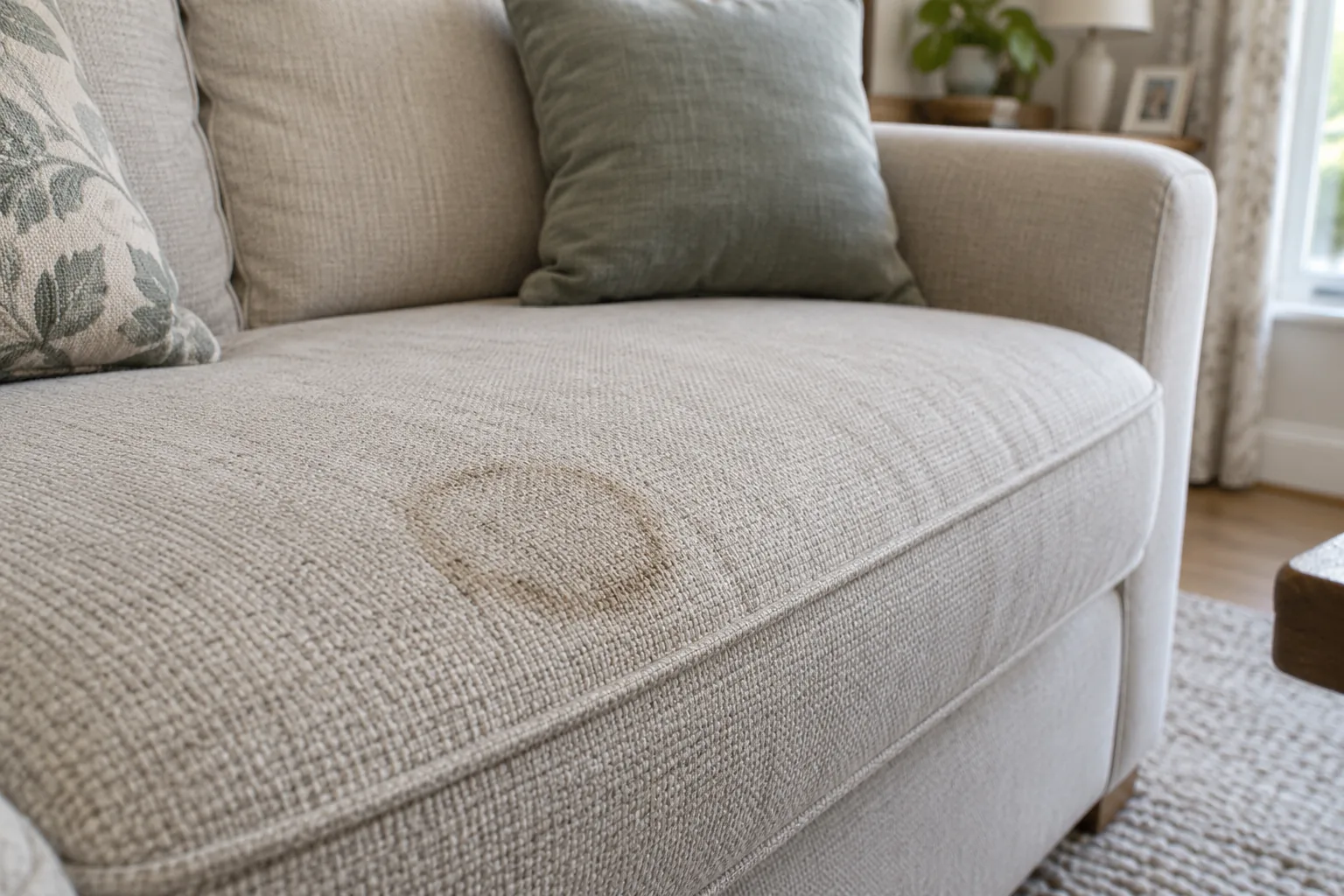
Direct answer: A water ring on a fabric sofa is a drying boundary, not a diagnosis. It may contain moved soil, cleaning residue, dye or material from beneath the cover. Check the fabric and spill history before adding more liquid.
A pale ring on a sofa cushion often appears after somebody tries to remove a small spill with water. The centre may look clean while the edge looks darker, yellow or brown. That pattern is frustrating, especially when the original spill was clear. Yet a visible boundary is not enough to identify a single cause. Soil can move outward with moisture; dissolved residue can collect at a drying edge; dye can move; and a mark hidden in the cushion can return as it dries. The useful first step is to work out which materials and events may be involved.
This guide is about an existing ring on upholstered fabric. If a large amount of liquid has soaked through the cushion, the question extends beyond its appearance: the filling and frame may need assessment. A quick surface clean cannot establish whether those inner parts are dry.
Read the shape and history before choosing a product
Think back to the first liquid contact. Was there a drink, a cleaning spray, rain from an open window, or water used to treat another stain? Did the mark become visible immediately or only after the upholstery dried? A ring that forms after home spotting may contain loosened general soil carried to the wet area’s edge. A brown mark after substantial wetting could involve material from beneath the face fabric. Colour moving from a cushion’s own dye, a contrasting trim or an item placed on it is another possibility.
Compare the marked panel with an unmarked panel in the same light. Look closely at the centre, boundary, seams and adjacent piping. A sharp outline may tell you where moisture stopped, but it does not identify the dissolved material. A fuzzy discolouration that tracks from a seam deserves a different inspection from a circular outline in the middle of a seat. Take a clear photograph in daylight and write down what was used on the area. Product names, dilution and the amount of water matter more than a guess that it was “just a water stain”.
The feel of the fabric matters too. A rough, stiff or sticky surface can indicate residue, while a texture change may indicate disturbed pile or finish. Do not keep wetting a mark merely because it grows lighter while damp: many residues only become visible again on drying. A professional assessment has to consider the dry result.
Why moisture can leave a darker edge
Water spreads through absorbent upholstery by capillary action. As it evaporates, dissolved material may travel toward a boundary and remain there. That material may be pre-existing soil, cleaning product, a spill component or a substance from deeper in the cushion. This movement is often called wicking. It can make an apparently successful spot treatment look unsuccessful the following day.
It is tempting to treat the outer line as a separate stain, but adding more liquid at the edge may simply move the boundary. Some upholstery fabrics also have unstable dyes or finishes that react visibly to moisture. A beige sofa can therefore show a brown line for quite different reasons, and those reasons call for different decisions. Without identifying the fibre, construction, backing and care instructions, there is no responsible universal recipe involving vinegar, detergent or steam.
A sofa’s everyday soil load is another part of the picture. A small wet patch on an otherwise soiled arm may dissolve oils and fine dirt, then leave a cleaner centre surrounded by the original darker fabric. In that case the ring is partly a contrast problem. Cleaning only the narrow outline cannot make the surrounding panel uniform. A trained cleaner may discuss treating the whole panel, but only after testing that the material can tolerate the chosen method.
A short assessment sequence
- Photograph the dry ring in daylight and note when it appeared.
- Check the sofa care label and list every product already used.
- Blot only if the area is still wet; do not scrub a dry ring.
- Ask a cleaner to assess the fabric, filling and likely source before treating a whole panel.
Safe first steps at home
If the area is still wet, gently blot with a clean white absorbent cloth. Press and lift; avoid rubbing across the fabric or piling on towels with coloured print. Remove an obvious source of liquid if it can be done safely, and allow air to circulate around the cushion. Keep children and pets away from a wet seat until it is dry. Check the maker’s care instructions before doing anything else.
If the ring is already dry, pause rather than repeatedly trying new products. Photograph it and inspect the label beneath the sofa or cushion. A removable cover does not automatically mean machine washable; some covers are meant to be removed for manufacture or replacement. The maker may specify a precise washing method or professional care. If the label cannot be found, ask the manufacturer for the model’s instructions. Do not use a code seen on a different sofa as a substitute.
Avoid soaking the cushion, ironing the ring, applying a hairdryer on high heat, or using a household carpet machine without upholstery guidance. Heat can alter finishes and set some marks, while uncontrolled water can reach filling or a timber frame. Strong chemicals can create a second problem that obscures the first. A small hidden test does not remove every risk: a cushion face may have been exposed to light and wear differently from the hidden area.
What a professional assessment should cover
Show the cleaner the entire cushion and the history of the mark. They should inspect the face fabric, seams, piping, backing and any accessible filling, and consider whether colour is stable. The scope of a test should be explained: a successful small spot does not prove that the full panel will dry evenly. Ask what outcome is realistic if the ring contains dye loss, colour migration or a permanent finish change. Cleaning can remove suitable residues; it cannot put missing colour or a damaged finish back.
A photograph of the dry ring and a list of earlier products are useful when you contact the team. The published price guide gives starting prices, although the appropriate work depends on the fabric and the assessment.
An appropriate method may involve controlled application and extraction, careful work over a complete panel, or a more cautious low-moisture approach. The choice depends on the material and the cause. Repeated treatment can be counterproductive if the ring keeps returning from deeper in the cushion. The cleaner should also explain how to support drying and when to assess the result. Our sofa cleaning service can assess the fabric and discuss treatment limits before work begins.
If the original event involved floodwater, wastewater or a large unknown spill, tell the cleaner at the first contact. The issue may be contamination of the inner cushion, not merely a cosmetic ring. A surface treatment should not be described as restoring an affected filling or frame without a separate assessment.
Set a fair expectation for the result
Compare before and after photographs taken in similar light, and wait until the material is fully dry before judging the boundary. Light and pile direction can change the apparent colour of upholstery across the day. A ring that improves but remains faint may reflect a permanent dye or texture change rather than incomplete effort. If it reappears, note how long the return took and whether the cushion felt damp; that information helps identify whether residue is moving from below.
For future spills, quick gentle blotting and the maker’s instructions offer a better starting point than a succession of household mixtures. If a mark remains, give the next cleaner the full treatment history. That makes a considered plan possible and reduces the risk of turning one small ring into a larger area of damage.
Frequently asked questions
Can plain water leave a brown ring?
Yes. Moisture can move existing soil or material from the fabric and cushion to a drying edge. The colour alone cannot identify which material moved.
Will cleaning always remove the ring?
No. Removable residue may improve, while dye change, finish damage or a source deep in the cushion may leave a visible boundary.