
A Leaking Appliance Soaked the Carpet: What Now?
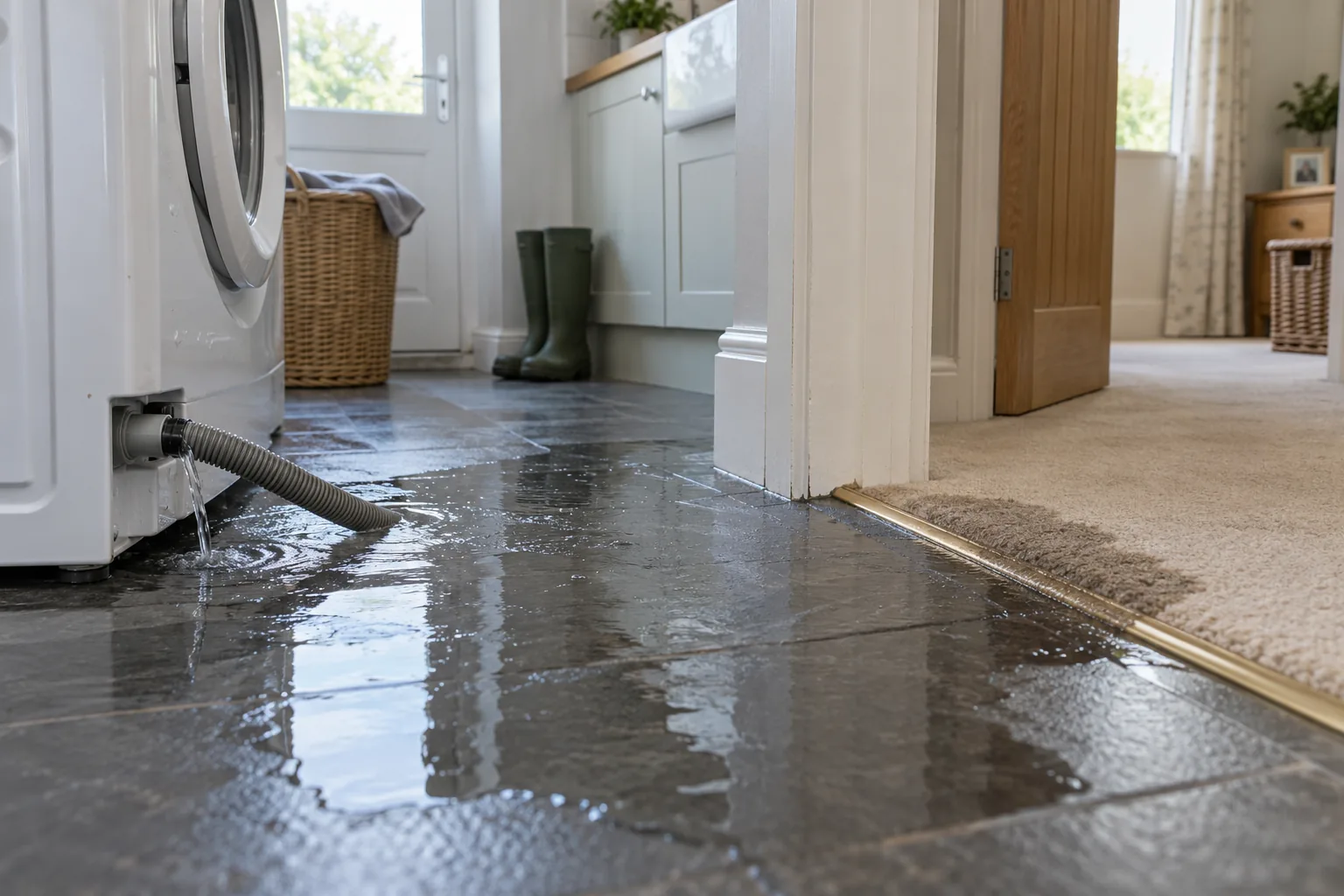
Direct answer: A soaked carpet needs assessment of the carpet, underlay and subfloor. Stop the leak safely, document the extent and arrange prompt water-restoration advice.
A washing machine hose fails and water spreads across the kitchen threshold into a carpeted room. The carpet may look only dark at the surface, yet water can reach backing, underlay, skirting and the floor below. This is no longer an ordinary stain-cleaning job. The priorities are safety, stopping the leak, recording the extent and arranging a drying assessment before hidden damp persists.
How you respond depends on the appliance, the source of water, the amount and how long it has been there. Clean supply water and water carrying detergent or wastewater pose different concerns. A routine carpet cleaner may help with surface soil later, but saturated materials need advice from someone equipped to assess water damage across all affected layers.
Practical steps for the customer
- Stop the water source if safe.
- Keep clear of electrical hazards.
- Photograph the area and note timing.
- Ask a restoration professional to check all layers.
Make the immediate area safe
If water is near electrical sockets, cables or the appliance, do not touch wet electrical equipment. Follow the appliance and household electrical safety guidance and seek qualified help if there is any doubt. Stop the water supply only where you can do so safely. Keep children and pets out of the wet area and avoid walking through water towards electrical items.
Identify whether the leak is still active. A plumber, appliance engineer or building maintenance team may be needed before drying can succeed. If the property is rented or managed, notify the responsible contact promptly. For a flat, consider whether water may have reached another unit or a shared area. Document the source and affected rooms without delaying essential steps to stop further damage.
The water itself matters. A split clean-water supply pipe is different from a washing-machine discharge, dishwasher leak or backed-up drain. Tell the restoration professional exactly where the water came from and whether detergent, food waste or sewage may be involved. Do not describe unknown water as “clean” simply because it looks clear.
Record the footprint of the leak
Take wide photographs and close views of the appliance, threshold, carpet, skirting and nearby furniture. Note the time you discovered the leak and the last time the area was known to be dry. If an insurer may be involved, ask about evidence before discarding damaged material. The London Fire Brigade advises photographing damaged belongings for a claim after flooding and consulting the insurer as necessary.
Move small, safe-to-lift items out of contact with water. Avoid dragging heavy furniture across wet carpet; it may tear fibres or cause injury. Furniture legs can transfer colour to damp pile, so protect the area and tell the assessor what remains in place. Do not put plastic sheeting over a wet carpet and assume it is protected: trapped moisture can slow drying.
An apparently small patch can spread under the carpet or along the floor. Look for wet skirting, a damp adjoining room or a mark beneath furniture. Do not lift fitted carpet casually to investigate; gripper strips can be sharp and the flooring may need a planned assessment. A professional can check moisture in the carpet, underlay and subfloor with suitable equipment.
Why surface drying is insufficient
If the carpet begins to wrinkle or its backing separates after the leak, the warning signs of carpet delamination deserve assessment before any later clean.
The Carpet and Rug Institute recommends using a professional trained in water restoration after a carpet is soaked, so the carpet, cushion and subfloor can all be dried. The US Environmental Protection Agency likewise states that carpet backing or padding must be dried along with the carpet to prevent mould. A surface that feels dry to a hand does not prove the layer underneath is dry.
Drying is time-sensitive. Guidance for clean-water damage commonly aims for prompt extraction and drying, often discussing a 24 to 48 hour window, but that is not a promise that every soaked carpet can be saved in that period. Material, contamination, temperature, underlay and how long the water was present affect the decision. Do not wait several days for a musty smell before asking for help.
Water extraction equipment, airflow and dehumidification may be needed. The right arrangement depends on the room and where moisture has travelled. Avoid using a standard household dry vacuum to pick up water. Do not point intense heat at one area or rely on a window alone if the underlay remains wet. A restoration company can explain what needs monitoring and whether material must be removed.
Cleaning versus restoration
An ordinary carpet clean aims to remove soil from carpet fibres using a process suited to their construction. Water-damage work asks a different set of questions: what was the water source, which layers are wet, whether they can be cleaned and dried, and whether a building element needs repair. A detergent pass over the face pile does not answer those questions.
If the water is contaminated, professional assessment is more important still. UK flood-recovery guidance notes that porous soft furnishings such as carpets can be extensively damaged by floodwater and may need a keep-or-discard decision. An appliance leak is not automatically the same as floodwater, but a wastewater leak can bring contamination that changes what is safe to retain. Describe the actual source rather than assuming all leaks are equivalent.
Once the leak is fixed and all layers are dry or replaced, our carpet cleaning service may be relevant for a carpet that has been judged suitable to keep. Do not book routine cleaning as the entire response to a soaked floor. Ask the restoration adviser when any later cleaning can occur and whether the carpet’s backing or fitting has been affected.
What to ask the assessor
Ask which materials have been tested for moisture, how they plan to dry or replace each layer, and how they will confirm the result. Ask whether the water source changes the cleaning or disposal decision. If the carpet has a natural backing, adhesive, a weak seam or wooden subfloor, mention it. Request a written record of what was found and what was done, particularly if an insurer, landlord or neighbour needs it.
Keep checking for a continuing source. A repaired hose can be followed by another leak from an appliance fitting or pipe. If dampness returns or an odour develops, contact the relevant professional rather than covering the mark with furniture. The visible carpet surface is only one part of the affected room.
If you are given a drying plan, note where equipment should stand and whether doors need to remain open or closed. Do not switch off or move hired equipment without asking the provider, because the arrangement may depend on measured room conditions. If the machine is noisy or obstructs normal use of the room, discuss that practical problem with the provider so the plan can be adjusted safely. Ask for a final moisture check rather than deciding completion from the appearance of the pile alone.
The key action is to treat saturation promptly and as a whole-floor problem. Stop the leak safely, record the event and get competent water-damage advice for carpet, underlay and subfloor. A clean comes later, if the material is suitable to retain.
Frequently asked questions
Is a dry-feeling surface enough?
No. Underlay and subfloor may retain moisture.
Can routine cleaning solve a leak?
Soaked layers may need extraction, monitoring, drying or replacement.