
In-Home Rug Cleaning: When Is It Appropriate?
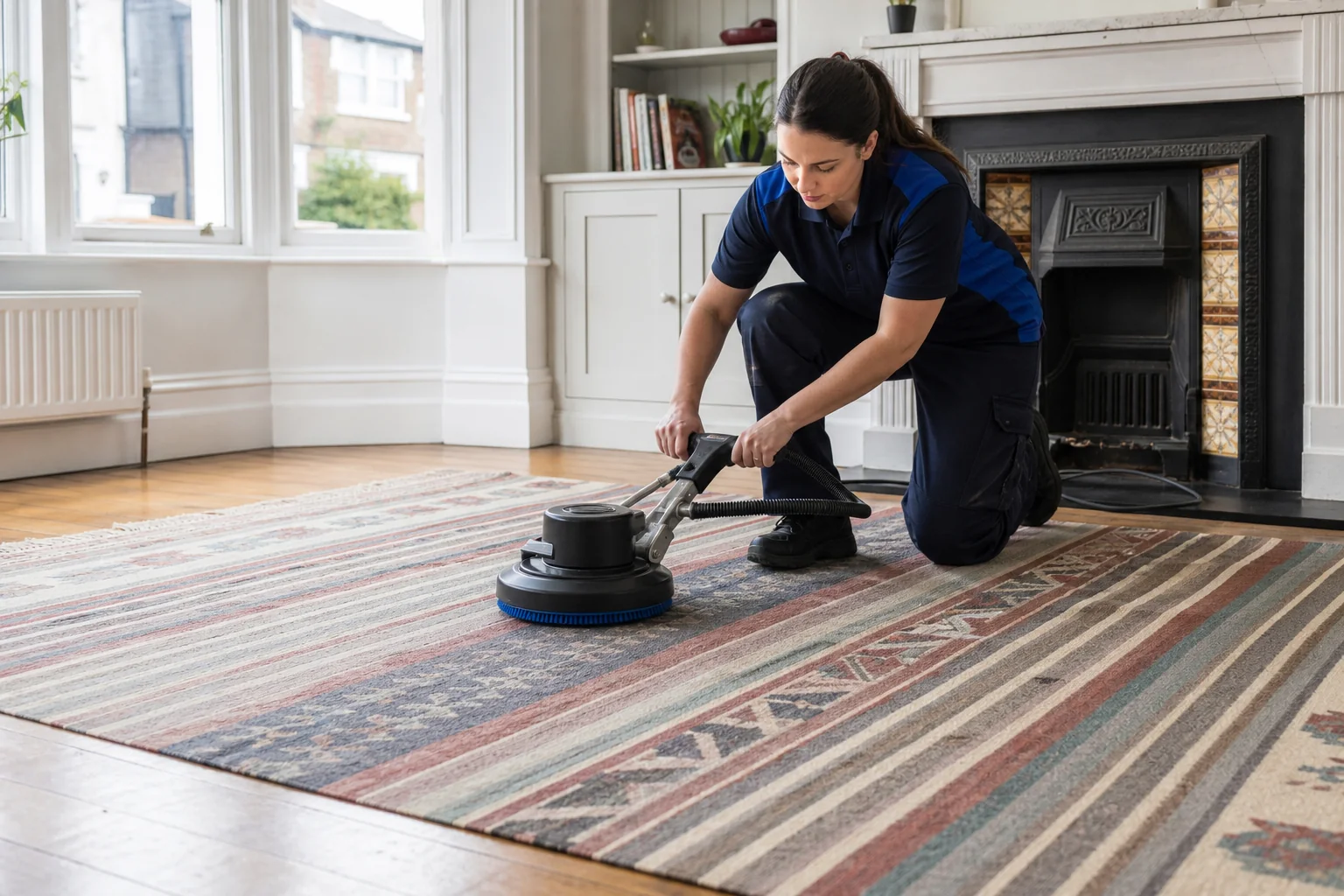
In-home rug cleaning can be practical for a sound rug whose fibres, dyes and backing tolerate the proposed method, and when the room allows safe protection and drying. It is not automatically suitable because the rug lies in a house or is too large to carry. A delicate foundation, unstable colour, failing adhesive or wet wooden floor may require a different approach. The decision should follow inspection of both rug faces and the surface beneath it.
Before requesting a quote, measure the rug and photograph its front, back, fringes and label. Note previous spills, home products and any colour that has already moved. If the rug is valuable or its origin is uncertain, tell the cleaner. A remote photograph helps plan the visit but cannot confirm every dye or backing condition.
What the room must allow
The technician needs access around the rug and a way to keep furniture, people and pets off it while it dries. A rug tucked beneath a heavy sofa or dining table may not be safely movable without help. An in-place clean on timber or laminate needs particular floor protection and a plan to verify that no moisture remains underneath. A non-slip pad can absorb liquid separately from the rug.
The Why Rug Backing and Construction Matter explains why a pile that feels dry does not settle the floor question. If a rug cannot be lifted or its underside checked, ask whether in-home wet treatment is appropriate. Do not let a damp foundation remain pressed against a vulnerable floor.
Rug construction sets the boundary
A modern synthetic rug with a sound, stable backing may be a reasonable in-home candidate. A hand-knotted wool rug, a silk detail or a fragile fringe may need specialist handling and controlled drying away from the room. Latex that is crumbling cannot be repaired by cleaning; moisture may expose more of the failure. A cleaner should examine the underside before promising a routine treatment.
Colour tests are also relevant. A bright border may release dye even if a plain centre appears stable. The rug colour-fastness guide explains why one spot test cannot guarantee a whole rug's behaviour. If the rug has old water lines or dye migration, a broad wet clean may make them worse.
What in-home work can reach
A technician can remove suitable dry soil and use a controlled cleaning process on accessible surfaces, with appropriate product and moisture recovery. The proposed method should address the actual soil: general dullness, an isolated food mark and a pet accident that soaked through the backing are not equivalent. A surface process cannot be represented as restoring every deep layer or the pad and floor beneath.
Ask whether the rug will be moved, whether the underside is treated and how fringes are handled. Ask what will remain if a mark is permanent dye loss or wear. The rug cleaning service should explain the scope before equipment is set up. A careful cleaner may change the plan after seeing an unstable edge or damaged backing.
When off-site specialist cleaning is a better discussion
An off-site process can provide space for inspection, controlled washing, rinsing and drying, but it is not automatically safe for every rug. Valuable or delicate pieces require the right expertise and method. Pet odour held deep in a foundation may also call for a more complete assessment than a light in-home pass. Ask about transport, documentation, insurance and the expected result if the rug will leave your property.
The home-versus-specialist guide compares those choices. If a low-cost rug has a severely failed backing, replacement may be more rational than either cleaning route. The point is to choose based on materials and condition, not to insist on a location.
Prepare and check the result
Remove small items around the rug and tell the cleaner about floor finishes, loose threads and old products. Do not drag heavy furniture alone. After in-home work, follow the drying instructions and keep traffic off the rug. Check pile, fringe roots, backing and floor when safe. Do not replace a damp pad or table leg on the rug too early.
For an initial assessment, send dimensions, photographs and history through the contact page. The price guide gives starting figures, but the on-site inspection should decide if the rug is an in-home candidate. A convenient treatment is useful only when the rug and room can support it.
An in-home candidate example
A modern synthetic rug with a sound backing, stable colours and ordinary traffic soil may be cleaned in a room where the floor can be protected and the rug dried on both sides. The technician still needs to test and explain the method. A similar-looking rug with deteriorating latex on timber is a different case, even if the pile is the same fibre. This comparison is why inspection of the underside and setting matters more than the convenient phrase “clean it where it lies”.
An awkward room example
A rug under a heavy dining table in a small flat may be hard to lift or dry safely. Ask whether the table must be moved, who will move it and whether the floor can be checked afterwards. Do not clear the room by dragging furniture across a delicate rug. If access is inadequate, an off-site process or rescheduled visit may be preferable. The scope and cost should reflect the actual room rather than an idealised open floor.
Drying space can be the deciding limitation. A rug cleaned in a furnished room may have nowhere to lie without feet or furniture pressing into it. If it must be lifted for floor protection, ask where it can be supported and how both faces will receive airflow. A fan in a corner does not guarantee the centre of a thick foundation is dry. A technician should give a practical check before the rug returns to timber. If the room cannot support this, off-site work or postponement may be a better plan than an in-home treatment carried out without a drying route.
In a flat with limited space, discuss whether the rug can be collected for an off-site assessment and who will move the furniture safely. Confirm the expected return date and where the rug will be inspected on delivery. If collection is unavailable, leaving a stable rug uncleaned until the room can support safe drying may be wiser than rushing a wet process. The room itself is part of the treatment plan.