
Colour Bleeding in Carpets: Why Testing Matters
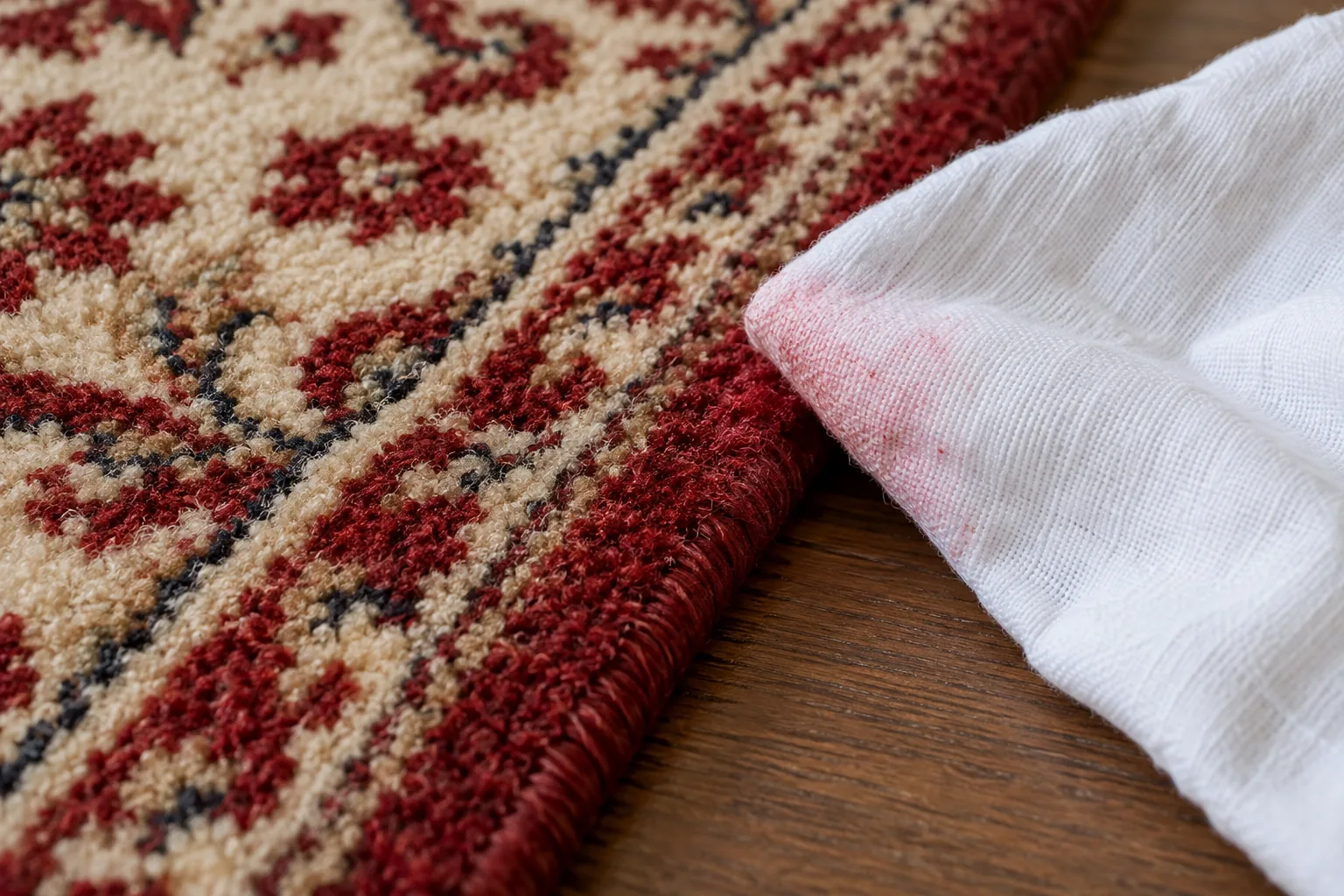
Direct answer: Dye can migrate during cleaning and spread into neighbouring yarns. A careful test of the actual colours and proposed treatment can reveal risk before wider work.
A dark border bleeding into a pale field, or colour transferring onto a white cloth during spot treatment, changes the cleaning decision. The concern is not ordinary soil: dye may move from one part of the carpet to another or into a cleaning cloth when moisture and chemistry are applied. Once colour has migrated, making it match the original pattern can be difficult or impossible.
Testing before wet treatment helps a cleaner identify an unstable area and choose a safer method. A test is evidence about a specific material, product and location; it is not a guarantee that every square metre will behave identically. That limit matters for patterned, multi-colour, old or previously treated carpets.
What colour bleeding looks like
Compare a true migrating dye with browning on wool carpet when the new mark is yellow-brown rather than the colour of a neighbouring yarn.
Look for a darker colour feathering across the edge of a light pattern, coloured streaks below a darker yarn, or a tint appearing on a clean white cloth after gentle blotting. A damp spot may show a halo as liquid travels outward. Colour moving from a red or blue section into cream yarn is particularly visible, though darker carpets can conceal migration until they dry.
Not every changing colour is dye bleed. Pile shading can make an area look dark from one direction and pale from another. A food or drink spill may itself carry colour. Brown residue from a natural backing can emerge after wetting. A cleaner needs the history, pattern and material to distinguish these possibilities. If colour transfers to a cloth in a cautious test, stop the home treatment and seek advice rather than continuing across a larger area.
Check the carpet label, retailer information or a spare sample if available. Some carpets contain multiple fibres or dyes. A small section may have a different construction from the rest, such as a border, inset or repair. A test in one neutral corner may not challenge a vivid border that is more likely to migrate.
Why water and products can change the result
Colourfastness describes how well colour remains in place under particular conditions. WoolSafe lists separate laboratory tests for fastness to water, shampoo, rubbing and light. That separation explains why a carpet that has not faded in sunlight may still respond poorly to a wet cleaner, and why a dye that withstands plain water may react differently to a product with another pH or ingredient.
WoolSafe’s wool maintenance guidance cautions that high alkalinity can contribute to colour bleeding in dyed yarns. The Carpet and Rug Institute also includes colourfastness in its cleaning-product test programme. Those facts support careful product selection and testing; they do not imply that an approved cleaner makes every old dye stable. The carpet’s own history and construction still matter.
Repeated home spot treatments can complicate the picture. A household product may have changed pH or left residue in one section. Another may have bleached a light patch rather than moved dye. Tell the cleaner the exact products used, even if they appeared to help at first. Do not add vinegar or an alkaline cleaner to “set” or “release” dye without material-specific advice.
Practical steps for the customer
- Identify contrasting borders or colours.
- Mention any previous colour run.
- Ask about material and colour tests.
- Stop if colour transfers to a white cloth.
What a careful test can reveal
A technician may use an inconspicuous location and a white absorbent material to see whether a proposed moisture and product combination transfers colour. They may test more than one colour or an old stain area if the pattern calls for it. The Carpet and Rug Institute’s spot guidance advises pretesting in a hidden area for colour transfer and fibre damage. The result helps determine whether the planned method is sensible.
Ask what was tested, where and with which product or process. A dry cloth test and a wet product test answer different questions. A small successful test reduces uncertainty but cannot eliminate it, especially where yarn batches, earlier cleaning and wear vary across a room. The cleaner may need to adjust moisture, dwell time, temperature or agitation, or decline wet treatment in a fragile area.
A failed test is valuable information. It may mean the area should be left untreated, addressed by a specialist or approached with a different method after further assessment. Hiding the test result to complete a whole-room job creates a greater risk. You should know the realistic trade-off before a visibly unstable carpet is cleaned.
Request that the outcome is recorded in the job notes, including the colour and location tested. If the cleaner elects to clean only part of the room, ask how the boundary may look once it dries. A partial clean can be sensible, but it may leave an obvious contrast where the uncleaned section begins. Discuss that aesthetic limit before work starts, especially where a patterned border frames a pale centre.
Situations that deserve extra care
Multi-colour woven carpets, rugs with contrasting borders, old repairs and hand-dyed materials can present several colour systems in one piece. An otherwise plain fitted carpet can also have an unstable decorative stripe or a dark trim. Previous spills or high-alkalinity products may have affected only one local area. Explain the location of any historical colour run to the technician before work begins.
If a carpet has already bled during a spill, photograph the dry result and avoid further wetting. If the carpet is a loose rug, a workshop with controlled drying and access to the back may be more appropriate than an in-home clean. The decision depends on value, construction and risk. No cleaner should promise that visible migrated dye can always be removed without changing original colours.
Our carpet cleaning service should be planned around pre-inspection and the result of appropriate tests. If a colour risk is identified, ask what area can still be safely cleaned, what may remain and whether specialist advice is needed. An honest limitation before treatment is preferable to a wider colour run afterwards.
If colour movement appears after cleaning
Contact the cleaning company promptly with photographs of the whole area and the affected edge. Note when the change became visible and whether the carpet has fully dried. Do not rub it or apply a second product. Moisture can make colours look darker while wet; a dry assessment in consistent light is needed before deciding what has migrated.
The cleaner can review the pretest, products, room conditions and earlier photographs. A limited correction may be possible in some cases, but there is no universal “reverse dye bleed” recipe. Treatment could affect the original pattern, so ask for the expected improvement and risk before proceeding. If an independent specialist is needed, preserve the evidence and product history.
For future cleaning, retain the results of any colourfastness assessment. Mention them at the next appointment, particularly if a different company attends. A carpet’s past behaviour is useful information, though it still does not replace a current inspection. Testing matters because it turns an invisible risk into a decision you can discuss before the colour moves.
Frequently asked questions
Does one successful test guarantee no bleeding?
No. Other colours and areas may behave differently.
Is a dark patch always dye bleed?
No. Pile shading or a spill may resemble it.