
Mattress Foam Layers: When Surface Cleaning Is All That Is Safe
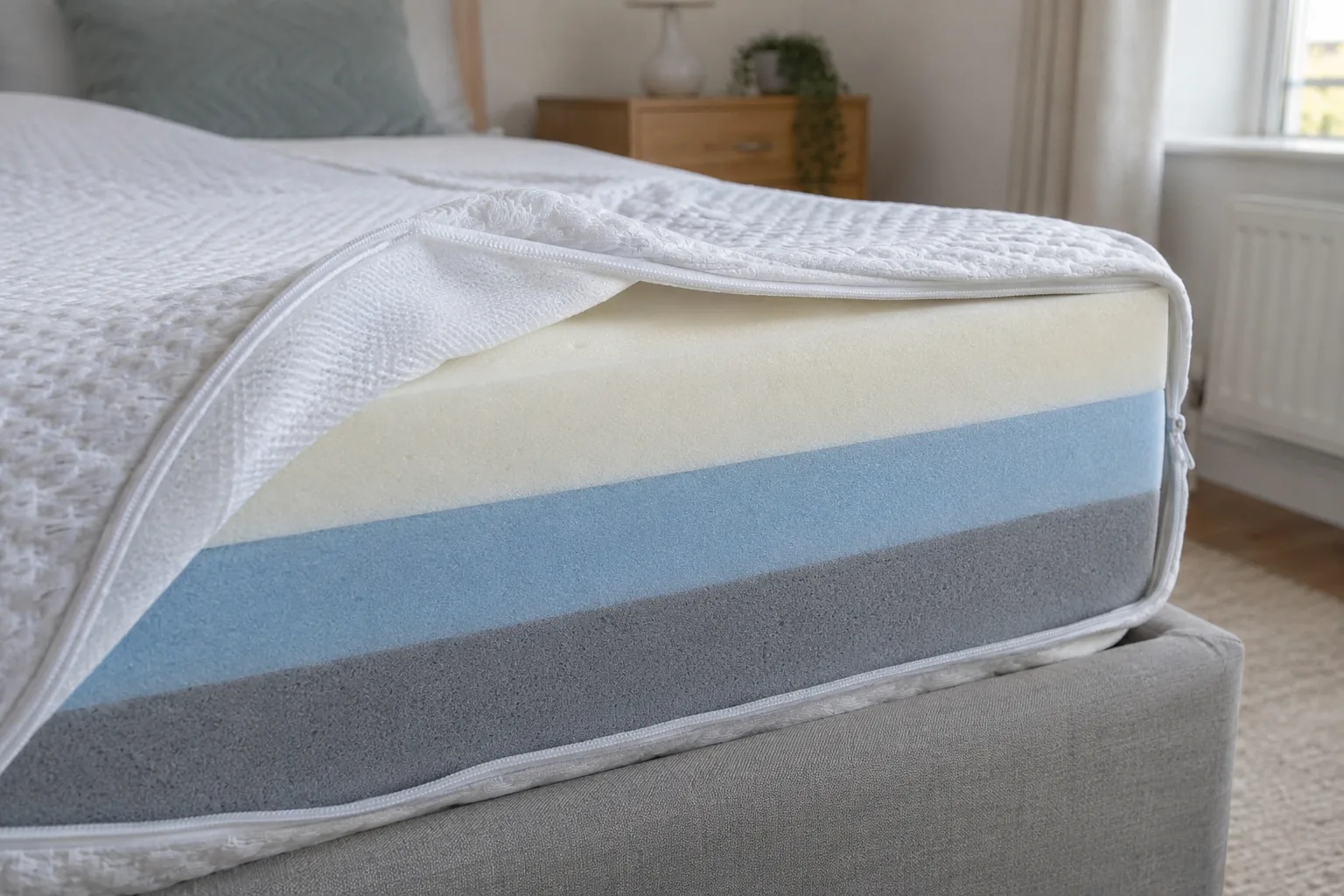
A foam mattress can have a washable outer cover over layers that should never be wetted. From the outside, those layers are easy to forget. An old stain on the ticking can make it tempting to apply a large amount of liquid in the hope of reaching deeper material. That may create a much harder drying problem and, for some products, damage the foam itself. The right scope of cleaning begins with the maker’s instructions for the exact model.
Direct answer: For some foam mattresses, cleaning the outer cover or ticking is the safe limit. Makers may explicitly prohibit washing, sponging or steaming the foam core. A surface clean cannot prove that a deeply soaked inner layer has been restored.
This guide concerns layered foam mattresses and the boundary between cover care and interior care. A clean-looking cover is not proof that a deeply contaminated core has been cleaned. Equally, a stained cover does not always mean the foam below is affected. The history of the spill and the condition of the mattress are essential.
Identify the layers you are dealing with
Product information may describe memory foam, support foam, latex-like material or other comfort layers. A mattress can combine several types. The top cover may be quilted with additional padding; beneath it may be an inner fire barrier or liner. Do not remove or cut such layers without manufacturer guidance. A zip can be part of manufacture and not an invitation to dismantle the mattress.
Check the label, care leaflet and manufacturer’s product page. Look separately for instructions about the removable cover and the foam core. Some brands allow the cover to be washed but explicitly prohibit washing, sponging or steam cleaning the foam. Other models may have a non-removable cover requiring surface care only. The fact that a different mattress from the same brand has a washable cover is not enough to decide for yours.
If information is missing, photograph the labels and ask the maker. This is particularly useful before booking professional work because a cleaner needs to know the limits. Do not rely on the words “memory foam” alone: it does not describe the adhesive, cover, thickness or ventilation design of the whole mattress.
Why a deep wet clean can be a poor fit
Foam is thick, and drying an inner layer is harder than drying ticking exposed to air. Liquid may enter at a seam or through a cover, spread between layers and remain out of sight. The surface can feel dry while deeper foam is still affected. A wet extraction tool cannot guarantee that all liquid introduced into a multi-layer core is removed. Heat applied to the top may not reach the inner area evenly and may harm materials.
Some foam manufacturers warn directly that soaking or cleaning fluids can cause irreversible damage to their material. Those warnings are product-specific, but they demonstrate why a broad claim that any foam mattress can be “deep steam cleaned” is unreliable. Steam is still moisture and heat. A machine may improve the visible cover while leaving the inner core unchanged. The method should be described honestly in terms of what it actually reaches.
A mattress that was soaked by a major spill, floodwater or contaminated liquid raises a different question from routine surface soil. If the inner foam cannot be cleaned and dried to an acceptable standard, replacement may be more sensible than repeated surface work. No one should imply that a perfumed top layer resolves what is inside.
What can be done at the surface
Routine care may include a washable protector, laundering of an approved removable cover and gentle vacuuming, depending on the maker’s directions. Keep bedding and protectors clean and dry. For a fresh small spill, blot the visible liquid promptly with clean white absorbent cloths, avoiding pressure that forces it inward. Check whether the cover can be removed; if so, follow its washing and drying instructions separately. Do not put the foam core in a washing machine because the cover can be laundered.
A surface mark that returns after drying may need the different assessment described in the guide to mattress tide marks. Send the mattress model and care-label photograph through the contact page before asking for treatment of its foam layers.
For a fixed cover, the maker may allow limited upholstery-style spot care. Use only the permitted method and amount. An old tide mark may remain even after removable soil is treated. Repeated wetting is unlikely to help if the source of the mark is deeper. Record what has been applied and let the area dry fully before deciding whether further treatment is justified.
Avoid spraying an entire mattress with strong disinfectant, bleach or fragrance in an attempt to “sanitise” the core. Such products may be unsuitable for skin-contact fabric and can leave residue or odour without reaching inner contamination. A claim about disinfection requires a validated process, material compatibility and the right exposure conditions. A surface treatment should be described as surface treatment.
Questions to ask a cleaner
Show the cleaner the product instructions and the history of the issue. Ask exactly what material will be treated: the removable cover, the fixed ticking, the comfort layer or some combination. How much moisture will be applied? How will it be removed? How will you know when the mattress is dry enough to remake the bed? If the maker prohibits wetting the foam, the proposed process must respect that limit.
Our mattress cleaning service can assess the visible surface and explain whether the mattress’s care instructions support treatment. There may be useful cleaning that can be done without claiming to restore an inaccessible core. If the mattress is structurally failing, sagging or deeply contaminated, the best advice may be to replace it rather than pay for work with little likely benefit.
Ask for a realistic result on staining. A visible change in the cover may be permanent colour loss, aged residue or a mark from a spill that travelled inward. The cleaner can test the surface response where appropriate, but no small test proves the condition of every hidden layer. A quote should leave room for that uncertainty.
Aftercare and a future barrier
After approved cleaning, keep sheets and protectors off until the treated material is completely dry. Room ventilation and airflow around the mattress help; do not trap it on an impermeable surface if the maker requires a ventilated bed base. Do not use direct high heat to force a quick result. Check the mattress edges and underside that can be safely accessed, and report any persistent dampness or odour.
A suitable washable protector can reduce future contact with spills and body soil. Follow its washing instructions and ensure it is dry before refitting. It is a barrier for future events, not a remedy for a damp core already hidden below. Understanding that distinction helps preserve the mattress and keeps cleaning claims honest: sometimes the most responsible service is a careful clean of the cover and clear advice about what cannot be reached.