
Mud on Carpet: Why Waiting Can Be Safer
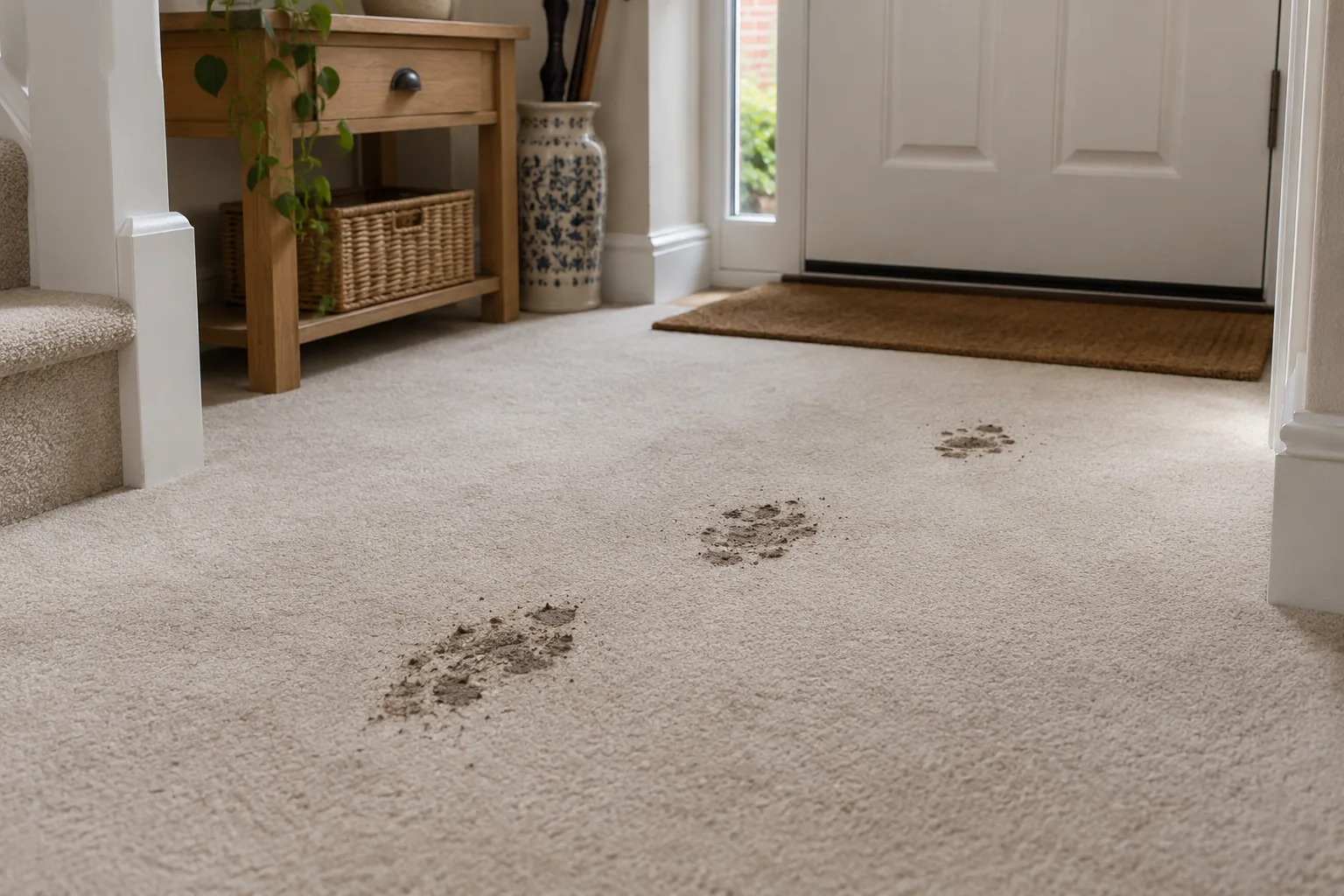
Direct answer: Ordinary mud may be easier to vacuum after drying. Keep the area clear, remove dry particles gently and assess any remaining mark before adding liquid.
Wet mud on a light carpet invites an immediate scrub. That often spreads the soil and pushes fine particles further into the pile. If the area is a small tracked-in mark and there is no other contamination, allowing the mud to dry before lifting loose particles can be the safer first move. The exact response changes if the carpet has been soaked, the mud contains a contaminant, or the material is especially delicate.
The objective is to remove the dry grit without grinding it into the yarn, then assess any remaining colour. A carpet that still looks brown after vacuuming may hold an attached stain or simply have compressed pile. Adding detergent before separating those causes makes the job harder.
Stop the trail at the doorway
Keep foot traffic away from the marks while they dry. Remove muddy shoes outside the room, place a suitable mat at the entrance and clear any loose clumps that can be lifted without smearing. If wet lumps sit on top of the carpet, use a blunt spoon to take away only the obvious excess. Do not scrape across the pile or drag a cloth through a wide route.
Take a photograph if the marks are extensive or in a rented property where condition records matter. Note whether the source was an ordinary garden path, building work, a sports field or something else. Soil can contain grit, clay, plant material, paint or other substances. A cleaning plan for plain tracked-in mud may be unsuitable if the mark contains cement, oil or an unknown chemical.
For a few wet footprints, there is usually no reason to add more water. Work on keeping the area undisturbed until it is dry enough for safe vacuuming. If the carpet or underlay is actually saturated, address that moisture separately; waiting for a flood to dry by itself is not the same as letting a small mud deposit harden.
What drying changes
As mud dries, some of the solid material becomes loose enough to lift mechanically. The Carpet and Rug Institute’s care guide recommends breaking up or scraping dry solid spills with a blunt object and vacuuming the remaining material. That principle is useful for ordinary mud: remove the part that is no longer bonded before considering a wet spot treatment.
Do not crush a hard clod into the pile with your shoe to “make it vacuumable”. Break it gently at the surface where the carpet construction allows, then use a vacuum head suited to the fibre and pile. A loop-pile carpet with a snag or an open seam needs special care so the tool does not catch it. If you are unsure, leave the stubborn piece for a technician rather than pulling fibres out with it.
Vacuum in unhurried passes and maintain the machine so suction is effective. Empty the container if full. Keep the head level instead of pressing it hard into the carpet. Fine dry grit can abrade yarn over time, so remove as much as possible. If the carpet is still damp, wait; vacuuming a wet area with an ordinary household machine may be unsafe or ineffective.
Practical steps for the customer
- Stop further muddy traffic.
- Let ordinary mud dry where safe.
- Vacuum particles with a suitable setting.
- Seek advice for remaining colour or odour.
Assess what is left before adding liquid
A route that remains dark after dry soil removal may also have compressed pile. The flattening-versus-dirt guide helps separate that texture change from a removable mark.
After the loose soil has gone, look at the mark in daylight. A pale brown tint may remain because fine clay particles are attached to the fibres or because the mud carried another substance. A dark route may also involve crushed pile and pre-existing soil. Compare the affected area with the surrounding carpet. Is the texture the same? Is the mark a sharp footprint shape or a broad route used every day?
Do not assume that a home detergent will remove the rest. Washing-up liquid can leave residue if not rinsed appropriately, while too much water can carry particles further into backing. Strong stain removers may change dyes or protective treatments. The Carpet and Rug Institute advises testing a suitable spot product in an inconspicuous place and blotting rather than scrubbing. Manufacturer instructions for the actual carpet take priority.
If you try a product approved for that carpet, use a small amount as directed and stop if colour transfers to the cloth or the pile changes. Do not mix products. Photograph the area before and after, and tell any professional what was used. For wool, viscose or a carpet with natural backing, seek material-specific advice before a wet treatment.
When to call a cleaner
A professional assessment is sensible if a large area is affected, the soil source is unknown, a residual mark remains after dry removal, or the carpet has delicate fibre or weak backing. Give the company a whole-room photograph and a close view. Mention whether the mud was tracked in on shoes, carried in with a pet or caused by building work. The more accurate the source, the easier it is to judge whether a routine carpet clean will address it.
Our carpet cleaning service can be planned for tracked-in soil once the carpet and its condition have been assessed. Ask whether the cleaner expects to remove dry particles first, whether a targeted spot treatment is needed and how the room will dry. A broad muddy route through a hallway may warrant cleaning a larger area so the result does not leave an obvious clean patch against old soil.
Cleaning can remove suitable soil but not restore fibres abraded by grit or replace colour already altered by a chemical in the mud. If a mark remains after appropriate treatment, ask whether it is likely residual colour, wear or a different contaminant. Repeating the same aggressive scrub is unlikely to improve a structurally worn area.
Prevent the next incident
Entrance matting works only when it has room to collect soil and is itself kept clean. A mat full of dry grit can become another source of tracked-in particles. Provide a convenient place to remove footwear, especially on wet days, and vacuum the entrance zone before grit is carried farther into the house. If pets bring in garden soil, a towel and a short pause at the door may limit the trail.
After decorating or landscaping work, manage the source rather than cleaning the carpet repeatedly while people still carry soil across it. Protect routes with a suitable temporary covering that cannot slip or trap moisture, and remove it once the work is finished. Then assess whether the carpet needs an overall clean.
For a small ordinary mud mark, patience is a practical tool: stop new traffic, let the deposit dry, lift loose solids gently and vacuum. Only then decide whether the remaining mark needs a spot method or professional treatment. That sequence protects both the fibres and your ability to judge what is actually left.